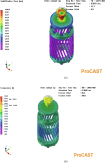
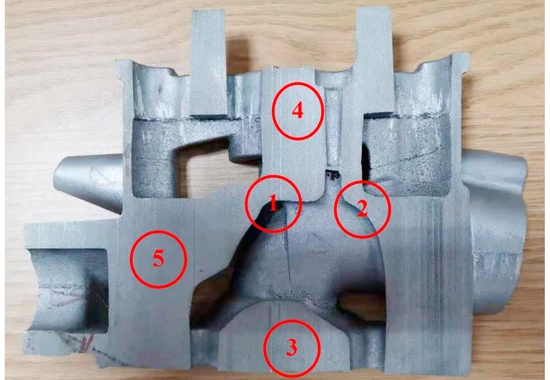
Suraj Marathea Carmo QuadrosbaDepartment of Mechanical, Don Bosco College of Engineering, Fathorda, Madgoa Goa 403602, IndiabDepartment of Mechanical, Assam Don Bosco University, Tapesia Gardens, Kamarkuchi Sonapu, Assam 782402, India Available online 11 April 2021. Abstract This paper identifies the approximate height of thermal hot spots in casting components manufactured by high pressure die casting. Certain assumptions
by Bing Zhou,Yonglin Kang *,Mingfan Qi,Huanhuan Zhang andGuoming ZhuSchool of Materials Science and Engineering, University of Science and Technology Beijing, Beijing 100083, China*Author to whom correspondence should be addressed.Materials2014, 7(4), 3084-3105; https://doi.org/10.3390/ma7043084Received: 24 March 2014 / Revised: 4 April 2014 / Accepted: 4 April 2014 / Published: 15 April 2014(This article belongs to the Special Issue Light Alloys and Their Applications)
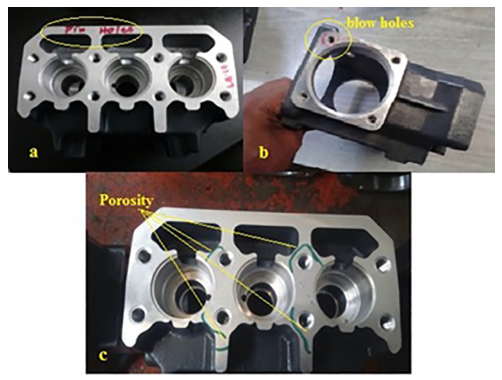
S.AravindP.RagupathiG.VigneshDepartment of Mechanical Engineering, Karpagam Academy of Higher Education, Coimbatore, Tamil Nadu 641 021, India Received 30 June 2020, Accepted 14 July 2020, Available online 14 August 2020. Abstract A numerical investigation was carried out with the help of computer based casting simulation software to eliminate defects such as shrinkage due to solidification, cracks, imperfect
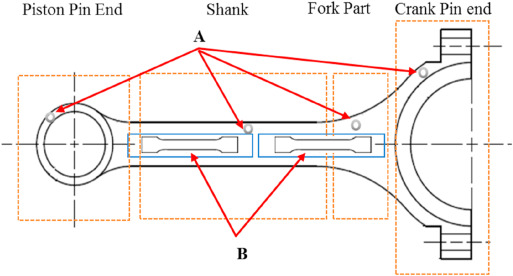
DrissEl KhoukhiabcNicolasSaintierbFranckMorelaDanielBellettaPierreOsmondcViet-DucLeaaLAMPA, Arts et Métiers Institute of Technology, Angers, 49 035 Cedex, FrancebI2M, Arts et Métiers Institute of Technology, Talence, 33170 Cedex, FrancecGroupe PSA, Carrières-sous-Poissy, 78955 Cedex, France Received 18 November 2020, Revised 16 March 2021, Accepted 2 May 2021, Available online 4 May 2021. Highlights Point Process Theory is an efficient way to characterize
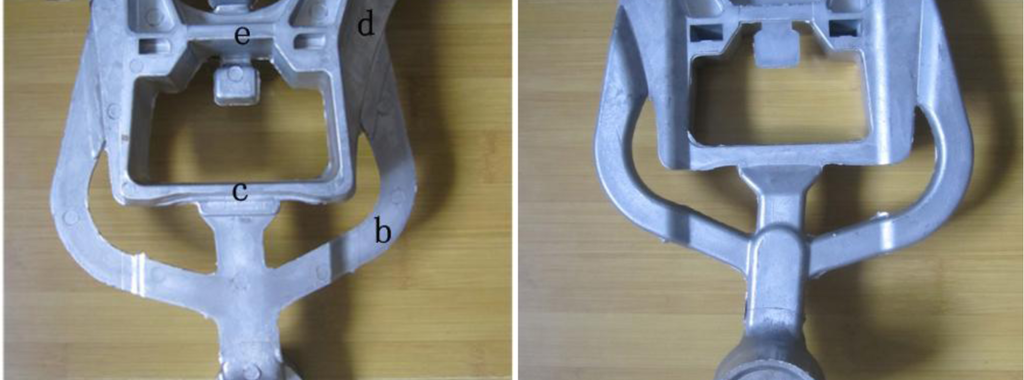
by Daliang Yu 1,Wen Yang 2,Wanqing Deng 2,Songzhu Zhu 2,Qingwei Dai 1,3,* andDingfei Zhang 31School of Metallurgy and Materials Engineering, Chongqing University of Science and Technology, Chongqing 401331, China2Chongqing Zhicheng Machinery Co., LTD, Chongqing 400039, China3College of Materials Science and Engineering, Chongqing University, Chongqing 400045, China*Author to whom correspondence should be addressed.Metals2021, 11(1), 97; https://doi.org/10.3390/met11010097Received: 27 November 2020 / Revised: 25 December 2020 / Accepted:
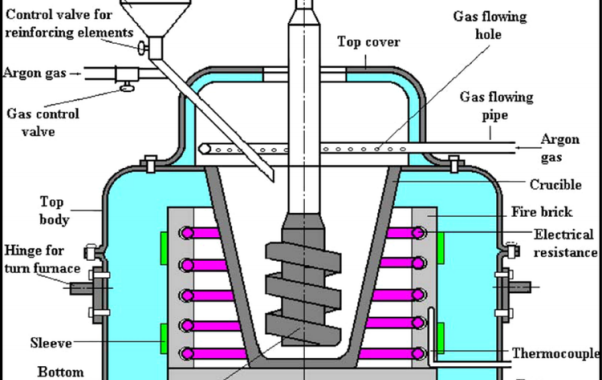
R Palanivel, Shaqra University, Riyadh, Saudi ArabiaI Dinaharan, Tsinghua University, Beijing, ChinaRF Laubscher, University of Johannesburg, Johannesburg, South Africa 금속 기반 복합 부품 생산을 위한 주조 경로 Introduction A composite material is a material system consisting of a mixture or combination of two or more nano-micro- or macro-based elements with a separating interface where the
YuanLia, JinxiangLiua, QiangZhangb, WeiqingHuangaa School of Mechanical Engineering, Beijing Institute of Technology, Beijing 100081, Chinab Liaoshen Industries Group Co. Ltd, Shenyang 110045, China Abstract Due to the complex structure of the large cylinder head, it is prone to produce uncontrolled casting defects and uneven microstructure distribution. In order to predict the porosity defects and secondary dendrite arm
SazianaSamat, Mohd Zaidi, OmarAmir Hossein Baghdadi, Intan Fadhlina Mohamed, Ahmad Muhammad AzizDepartment of Mechanical and Manufacturing Engineering, Faculty of Engineering and Built Environment, Universiti Kebangsaan Malaysia, 43600 UKM, Bangi, Malaysia Abstract The thixoforming process with feedstock preparation yields a fine microstructure and enhanced mechanical properties relative to other traditional casting processes. However, the thixoforming process
Joshua Thomas JamesonBurda, Elizabeth A.Moorea, HeshamEzzatbRandolphKirchainaRichardRothaa Materials Systems Laboratory, Massachusetts Institute of Technology, 77 Massachusetts Ave, E19-695, Cambridge, MA 02139, United Statesb WorldAuto Steel/American Iron and Steel Institute, 2000 Town Center, Suite 320, Southfield, MI 48075, United States Highlights Global demand for and adoption of battery electric vehicles is on the rise. To achieve increased