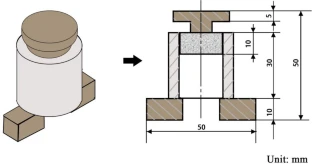
Patricia Erhard, Dominik Boos & Daniel Günther Proceedings of the Munich Symposium on Lightweight Design 2021 pp 35–43Cite as In-Mold Coating in Pressing of Natural-Fiber-Reinforced Salt Cores for High-Pressure Die-Casting Applications Patricia Erhard, Dominik Boos & Daniel Günther Conference paper First Online: 06 August 2022 14 Accesses Abstract High-pressure die-casting (HPDC) is known as a highly productive manufacturing process for light metals.
David Blondheim Jr. & Alex Monroe Abstract Porosity formation in high pressure die casting (HPDC) impacts mechanical properties and casting quality. Much is published regarding micro porosity and its impact on mechanical properties, but there is limited research on the actual formation of macro porosity. In production applications, macro porosity plays a critically important role in casting
도전적인 알루미늄 HPDC 자동차 부품을 위한 로컬 스퀴즈 기술 Elisa Fracchia, Federico Simone Gobber, Claudio Mus, Raul Pirovano & Mario Rosso First Online: 05 February 2022 Part of the The Minerals, Metals & Materials Series book series (MMMS) Abstract A key issue in producing high-quality aluminium automotive components by the High-Pressure Die Casting process (HPDC) is minimizing the defects. For the HPDC technology,
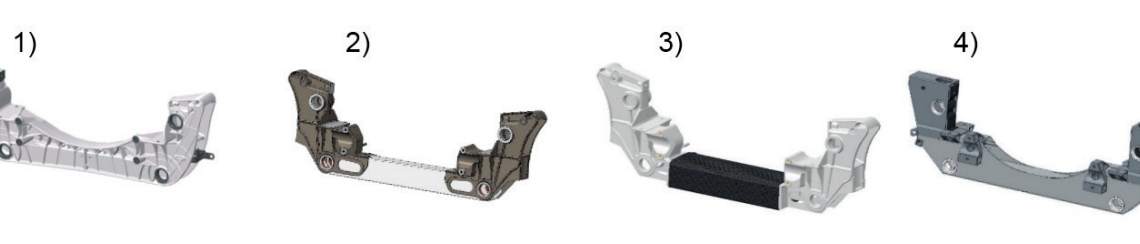
S. Cecchel, D. FerrarioThe purpose of the present paper is to enhance and deepen the lightweight optimization in automotive, in particular for commercial vehicles and buses. In detail, aim of this research is to develop a technically reliable and cost effective safety component for Light Commercial Vehicles (LCVs) in aluminum alloy. At this purpose, different
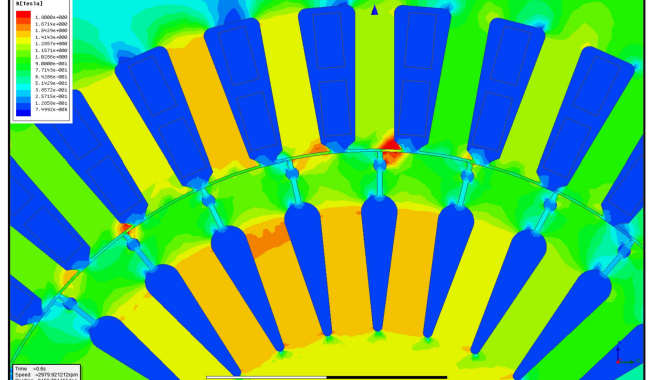
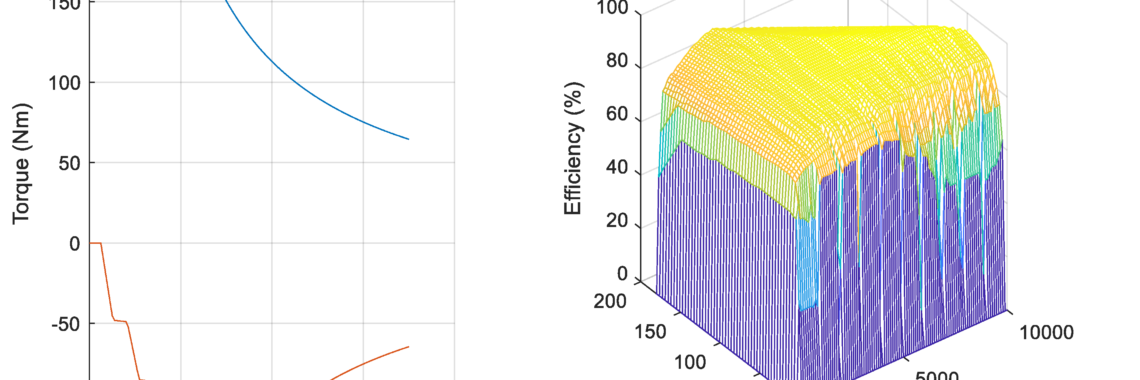
Ashwin D; Ashok S; Manglesh Dixit; Vinila Chavan All Authors Abstract This paper describes the design and simulation of 15 kW, 2 pole, 50 Hz, three phase induction motor to achieve IE4 efficiency level as defined by the International Electrotechnical Commission (IEC). For achieving higher efficiency, the motor is designed, optimized and simulated with copper die-cast rotor and
by Francesco Del Pero *,Lorenzo Berzi,Andrea Antonacci andMassimo DeloguDepartment of Industrial Engineering, University of Florence, Via di S. Marta 3, 50139 Florence, Italy*Author to whom correspondence should be addressed.Machines2020, 8(3), 51; https://doi.org/10.3390/machines8030051Received: 14 August 2020 / Revised: 30 August 2020 / Accepted: 31 August 2020 / Published: 3 September 2020 Abstract A thorough assessment of Life-Cycle effects involved by vehicle lightweighting needs a rigorous evaluation of
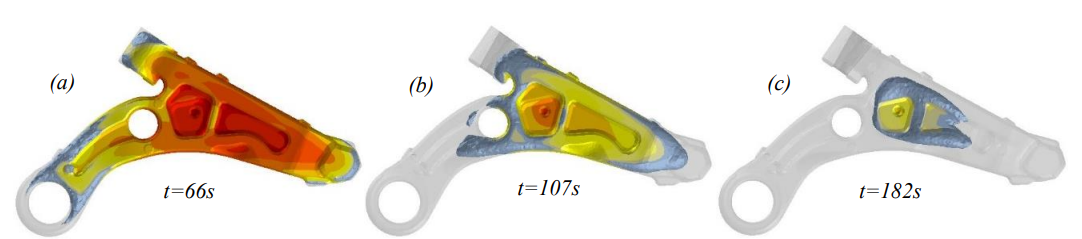
J Ou1, C Wei1,2, D Maijer1, S Cockcroft1, L A2, Y Zhang2, Z Chen2 and Z Zhu2 Published under licence by IOP Publishing LtdIOP Conference Series: Materials Science and Engineering, Volume 861, MCWASP XV: International Conference on Modelling of Casting, Welding and Advanced Solidification Processes 22-23 June 2020, Jönköping, SwedenCitation J Ou et al 2020 IOP Conf. Ser.: Mater. Sci. Eng. 861 012030 Abstract Die (permanent) casting is one of the
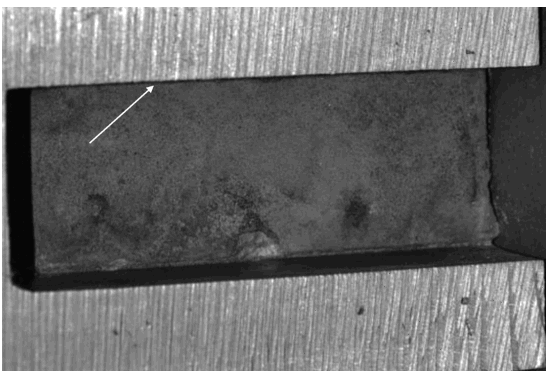
Jaroslav Beòo, Eli{ka Adámková, Franti{ek Mik{ovský, Petr JelínekV[B-Technical University of Ostrava, Faculty of Metallurgy and Materials Engineering, Department of Metallurgy and Foundry, listopadu 15/2172, 708 33 Ostrava-Poruba, Czech Republicjaroslav.beno@vsb.czPrejem rokopisa – received: 2013-09-26; sprejem za objavo – accepted for publication: 2014-09-05 1 INTRODUCTION The application of salt cores for the pre-casting of casting cavities and
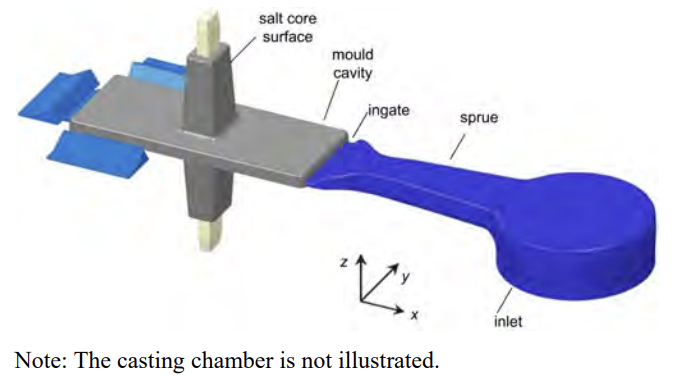
Sebastian Kohlstädt* and Michael VynnyckyDepartment of Materials Science and Engineering,KTH Royal Institute of Technology,Brinellvägen 23,100 44 Stockholm, SwedenEmail: skoh@kth.seEmail: michaelv@kth.se*Corresponding author Abstract In this work, the implementation of three turbulence models inside the open source C++ computational fluid dynamics (CFD) library OpenFOAM were tested in 2D and 3D to determine the viability of salt cores
Xuan-yu Liu, Wei-hua Liu, Xue-ting Wang, Lai Song, Fang-hai Xin & Ying-min Li International Journal of Metalcasting (2021)Cite this article 38 Accesses Metrics Abstract This paper aims to improve difficult cleaning and high core requirements in castings with complex internal cavities. The mixed salt was composed of NaCl, Na2SO4, BaCl2, and ceramic reinforced powder Al2O3 was added as core